Choosing between Smart Guard and traditional guarding depends on risk profile, site size, and required response quality.
Direct comparison
Smart Guard usually provides broader 24/7 coverage, stronger incident evidence, and lower operating cost over time, especially for larger sites.
Best-fit model
Many businesses benefit from a hybrid model: human guard at critical checkpoints plus AI-enabled remote monitoring for full-site coverage.
Total operating cost matters
Traditional guarding cost is not salary only. Once you include shift rotation, leave coverage, turnover, and supervision overhead, total operating cost becomes much higher than many budget plans assume. Smart Guard shifts a large part of that variability into a more predictable monitoring model.
Coverage and response quality
Human guards are effective in specific checkpoints, but multi-entry or large-area sites usually need simultaneous visibility across several zones. Smart Guard provides continuous multi-point monitoring and timestamped evidence, which improves verification quality and speeds up escalation decisions.
Safe migration plan
Use phased rollout: risk mapping, pilot deployment, alert tuning, and KPI-based optimization to ensure smooth transition.
- Week 1: Map high-risk assets and define critical monitoring zones.
- Week 2: Launch pilot coverage with daily incident review.
- Week 3: Tune alert rules to reduce low-value noise.
- Week 4: Lock operating model and publish KPI dashboard.
When hybrid deployment is best
In sensitive reception or customer-facing points, hybrid design often wins: one on-site guard for direct interaction plus Smart Guard for wide-area monitoring and structured evidence. This keeps human flexibility where needed while improving consistency site-wide.
Executive KPIs to track
Track incident count before/after rollout, mean response time, alert-to-action conversion, and coverage compliance by zone. These metrics convert security decisions from opinion to measurable operating performance.
Helpful Security Resources
Frequently Asked Questions
Does Smart Guard completely replace human guards?
Not always. It can replace multiple guards in many sites, while hybrid deployment is better in other cases.
Which is faster for detecting night intrusion?
AI-based monitoring with automated alerts is typically faster and more consistent than human-only detection.
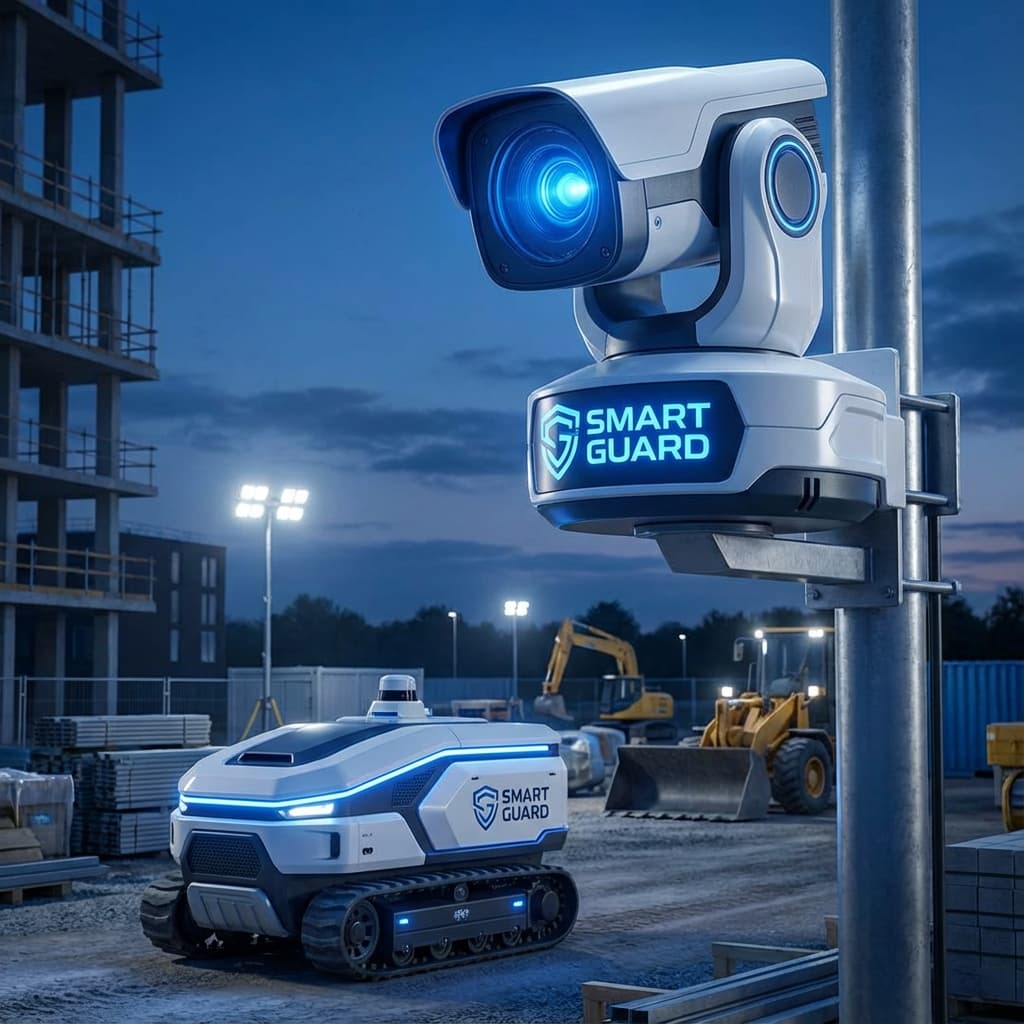
Is Smart Guard suitable for construction sites?
Yes. It is one of the best-fit scenarios due to large areas, multiple entry points, and continuous night coverage needs.